Heather A. Warfield - Journey to the Western Front
Meet Our Members
Journey to the Western Front
New Hampshire Daughter studies the role of pilgrimages in healing after World War I.
By Lena Anthony
Heather A. Warfield began her career as a site director for a number of mental health programs. When she decided to pursue doctoral studies, she knew she wanted to contribute to knowledge and practices that expand how—and where—healing and meaning-making can occur. She wrote her dissertation on the therapeutic value of pilgrimage journeys. “I’ve always believed healing and meaning-making aren’t confined to a therapist’s office—so many things people do can be therapeutic, including transformational travel,” said the member of Buntin-Rumford-Webster DAR Chapter, Concord, New Hampshire.
Dr. Warfield’s research focus on the psychology of pilgrimage led her to explore the universal themes in all types of pilgrimages, and eventually she discovered the widespread pilgrimages to the Western Front after World War I. These journeys were undertaken by service members, their families and other pilgrims who traveled to the once-devastated fields and villages of northern France in search of connection, remembrance and meaning.
“The war provoked an existential crisis for millions of people, and going on pilgrimages was one way people made meaning of the war and of their personal sacrifices,” said Dr. Warfield, who is a professor of Applied Psychology at Antioch University in Keene, New Hampshire. “During and after their pilgrimages, many American Veterans noted that they were able to see France being reconstructed and see the people, especially children, returning to normal lives.”
The pilgrimages were equally important for the families of Veterans, she said. “Some wives wrote about how important this was for understanding the wartime experiences of their husbands.”
In 2022, Dr. Warfield was named a Fulbright Scholar, which allowed her to spend a year immersed in her fieldwork—walking the routes of remembrance across northern France, interviewing pilgrims and tracing the many ways people continue to seek solace on the Western Front.
“I discovered so many wonderful people and stories that might otherwise have been lost to time,” she said. “French people have not forgotten the sacrifices of American service members and their families. They still remember American Veterans and commemorate these losses with remarkable dedication. Walking through villages where American soldiers fought and died, I was moved by the genuine gratitude that still exists more than a century later.”
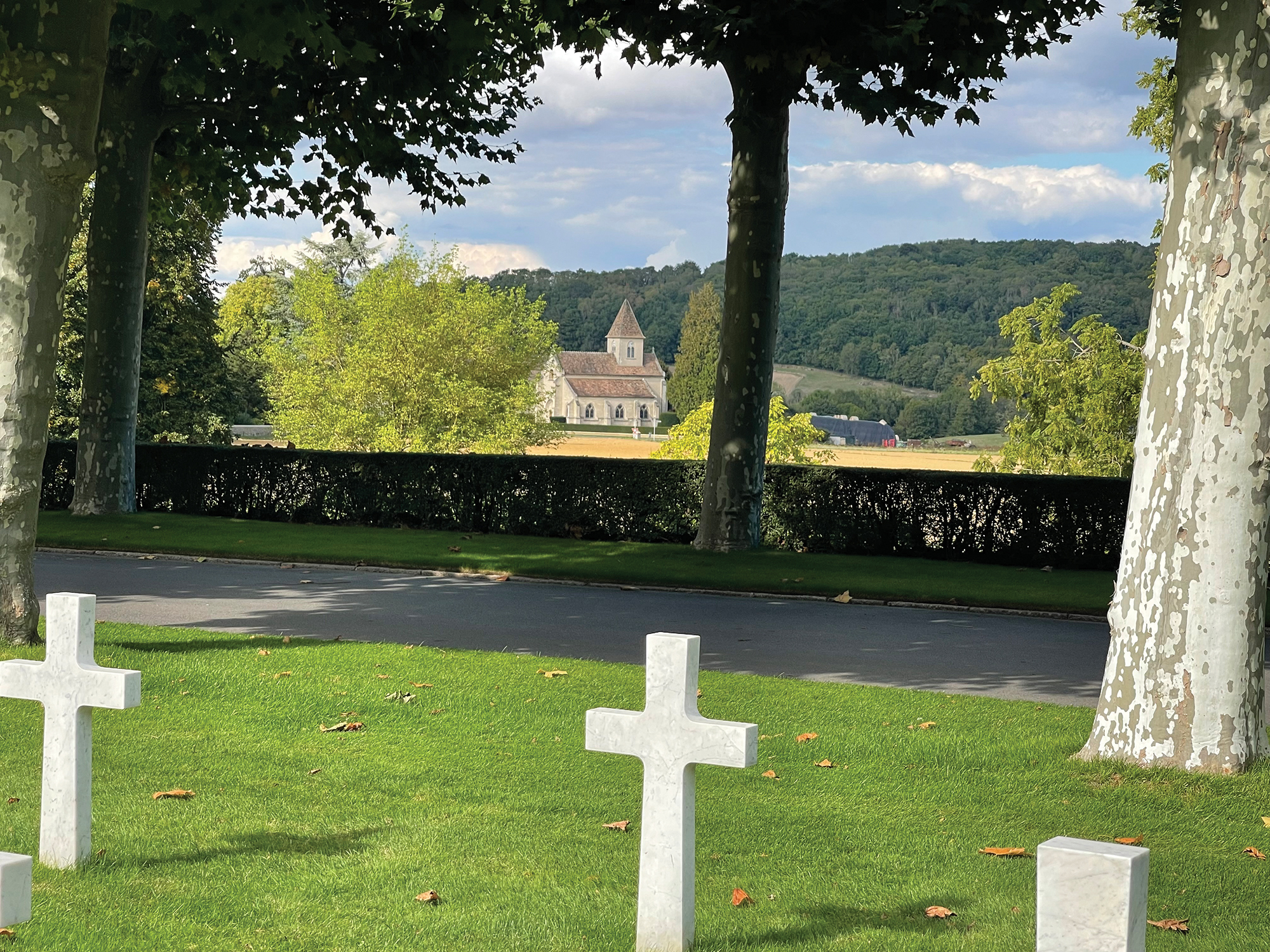
One discovery in particular hit home with Dr. Warfield. While doing research in the American Battle Monuments Commission archives, she discovered a notation in the visitor registry of the Aisne-Marne American Cemetery in Belleau from May 31, 1925, written by Mrs. John D. Fraser: “Visiting ground where son was killed, June 1918.” That son was Private Gilbert D. Fraser from Merrimack, New Hampshire, which is near where Dr. Warfield lives. “There is a public square dedicated to him, and I drive by this site regularly,” she said.
Dr. Warfield was also drawn to the history of St. Stephen’s Church, which has been a destination for pilgrims since 1929. The church was destroyed in July 1918 during the fighting in Belleau and later rebuilt as a symbol of new life rising from the ashes of war.
“A few years after the war, the Yankee Division Veterans Association decided to rebuild the church as their division memorial and as an active house of worship,” she said. “These Veterans didn’t just want to memorialize the dead; they wanted to create something living and useful for the French community that had suffered alongside them. They chose to rebuild a house of worship where families could gather, where children could be baptized, where life could continue.”
She’s now writing a book on a century of pilgrimages to Belleau and Belleau Wood and continues to visit the region regularly. Her next trip is scheduled for Memorial Day, when many return to the Western Front.
For Dr. Warfield, the path to DAR membership has been its own kind of pilgrimage. “I descend from a long line of ancestors who left their homes, and I was born and raised in rural Wyoming, disconnected socially and culturally from most of these ancestors and their stories,” she said. “My research into World War I pilgrimages and studying how people find meaning by returning to ancestral places helped me understand my own need for connection.”
For someone who has spent years studying how people find meaning through travel and remembrance, it’s fitting that Dr. Warfield’s own life has been a kind of pilgrimage—from her Wyoming roots to research trips in France and even a chapter living in Australia. Someday, she said, she would like to return to all of the places her ancestors left, not only for research, but also to walk the ground and reflect on how far her own path has carried her.
DAR and the Legacy of World War I Pilgrimage
According to Dr. Warfield, DAR members played vital roles in relief and remembrance during and after World War I—from Red Cross service and postwar reconstruction to organizing memorial efforts that became central to battlefield pilgrimages.
One standout was Margaret Overman Gregory, who served as North Carolina State Regent and helped found the Belleau Wood Memorial Association. The group purchased Belleau Wood in 1923 and dedicated it as an American shrine.
DAR members have also made pilgrimages to the Arc de Triomphe in Paris, where France’s Tomb of the Unknown Soldier is located. Alongside Gold Star Mothers, Daughters have participated in the nightly ravivage, the ritual of relighting the eternal flame that has burned without interruption since 1923.