
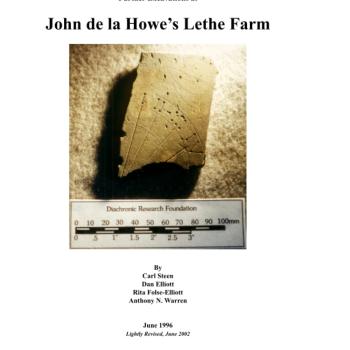


John de la Howe was a French physician who arrived in Charleston in 1764. That same year a group of French Huguenots arrived in the colony and settled in the New Bordeaux Township near the border with the Cherokee. Dr. de la Howe married a Charleston widow, and became a rice planter. He served as a Justice of the Peace and settled near Jacksonboro. The circumstance are mostly unspoken, but he and his wide split, and after the American Revolution, he moved to New Bordeaux with another companion. He named his new place after the mythical river in Hades called Lethe, whose waters allowed those who drank from it to forget their past troubles. He died without heirs in 1797 and left his land to be used as a school for needy locals - a function it continues to serve. His plantation was abandoned within a few years as his estate was settled, and the homesite has remained virtually untouched ever since. In archaeological terms this is extremely good news, because most of the arable land in the area was lost to erosion when cotton agriculture was introduced, and much of what remained was lost to logging. Thus this is one of the few remaining 18th century domestic sites in the vicinity. Carl Steen and the Diachronic Research Foundation received grants to explore the site.
*not eligible for DAR Library book credit*