America's Treasure
‘River of Grass’
Everglades National Park is a wetland wilderness
By Kim Hill
The largest subtropical wilderness in the United States, the Everglades is a shallow, 50-mile-wide “river of grass”—the wetlands and forests are nourished by water flowing southwest from Lake Okeechobee and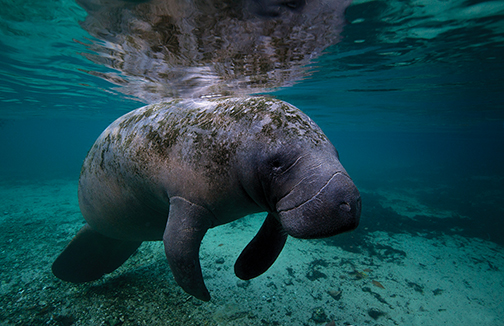 eventually reaching Florida Bay. Unlike many national parks created to preserve geological features, Everglades National Park in Florida was the first park established to safeguard a delicate and intricate ecosystem. This ecosystem faces numerous threats, including water pollution, habitat destruction, invasive species, and drainage of wetlands for agricultural use and residential development. Everglades is recognized as a UNESCO World Heritage Site, an International Biosphere Reserve and a Wetland of International Importance—one of only three locations in the world to appear on all three lists.
Unique Conditions Support Rare Flora and Fauna
The intertwining of hydrology and geology in the formation of the Everglades required unique conditions. Consisting primarily of permeable and porous limestone layers, the bedrock geology has been affected by weathering, erosion, sea level changes and organic compression. The subtropical wetland, coastal and marine ecosystems would not exist without this underlying geology, according to the National Park Service (NPS). Without water, the lifeblood of the Everglades, these ecosystems would cease to exist. Habitats within the nine distinct ecosystems sup-port plant and animal species encountered nowhere else.
In Everglades National Park, you will find the largest pre-served mangrove forest in the Western Hemisphere. The park is also a breeding site for 16 North American wading bird species. Nearly 40 threatened or endangered animal species inhabit the park, including the elusive Florida panther, the American crocodile, the American alligator, the West Indian manatee, the wood stork and the snail kite. More than 360 species of birds have been documented in Everglades National Park, attracting bird enthusiasts from around the world. Nearly 300 species of fish inhabit the freshwater marshes and marine coastline, while the park is also home to more than 40 species of mammals. Many of the Everglades’ best-known residents are reptiles, with South Florida being the only location where the American crocodile and the American alligator coexist in the wild.
Viewing wildlife from a safe distance is one of the park’s most popular activities. Visitors can glide along in canoes or kayaks; the 99-mile Wilderness Waterway takes days to navigate, but many shorter trails exist. Airboat tours—the quintessential Everglades experience—are available from authorized concessionaires. Narrated boat tours operate among mangrove forests, and naturalists guide tram tours from the Shark Valley Visitor Center. More favorites within the park’s boundaries include biking, boating, camping, fishing and hiking.
Advocates Rally to Save the Glades
Humans have inhabited south Florida for at least 10,000 years. When Spanish explorers arrived in the 1500s, they found the Calusa people living in villages along the southwestern coast. Their use of shells for tools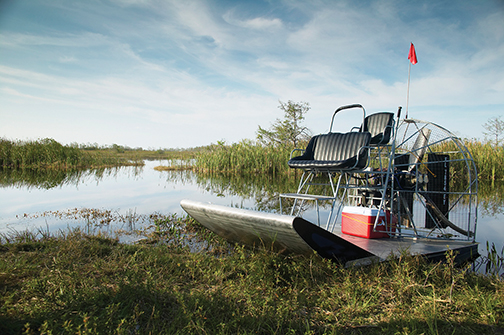 and architecture is evidenced by shell mounds still in the park today. By the time the English took control of Florida in 1763, the Calusa and other Indigenous groups had all but disappeared, decimated by European diseases.
Draining of the south Florida wetlands began in the 1800s. In the early 1900s, dredging turned large tracts of wetlands into tillable agriculture fields. A land boom in the 1920s included explosive growth in nearby towns such as Miami and Fort Lauderdale. Among the new Floridians were Ernest F. Coe and his wife, Anna, who moved to Miami in 1925. Coe, a landscape designer, was shocked to discover the casual slaughter of rare birds for their feathers and the removal of unique orchids from their natural Everglades habitat. In 1928, he organized the Tropical Everglades National Park Association to advocate for establishing a national park, a goal achieved in 1934. Coe organized an inspection tour of the area to drum up support; one notable participant was Marjory Stoneman Douglas, a freelance writer and former journalist for The Miami Herald.
Enamored with the Everglades, Douglas spent five years researching the area’s history and ecology. The influence of her subsequent book, The Everglades: River of Grass, has been compared to Rachel Carson’s Silent Spring. President Harry S. Truman dedicated the park in December 1947, the same year River of Grass was released. The Marjory Stoneman Douglas Wilderness, designated in 1978, comprises more than 1.2 million acres, making up the majority of Everglades National Park.
Things to See and Do
The park’s main visitor center, the Ernest F. Coe Visitor Center, is named for the man who became known as the “Father of the Everglades.” Other focal points of the park include the Pahayokee Boardwalk and Overlook, a boardwalk loop with a raised observation platform, and, in the northern part of the park, the Shark Valley Observation Tower, which offers 360-degree views. Boat tours guided by either a park ranger or a naturalist depart from the marina near the visitor center in Flamingo, where visitors can rent bikes, canoes, kayaks or motorboats or just take in the spectacular views of Florida Bay. The lower islands of Ten Thousand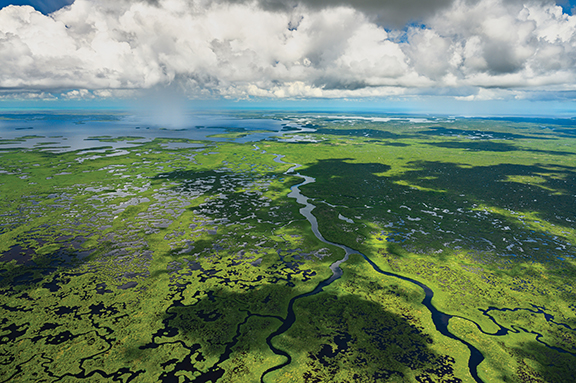 Islands, a 35,000-acre chain of islands and mangrove islets, are accessed by boat from the Gulf Coast Visitor Center area
Restoring the ‘Quiet Beauty’ of the Everglades
Despite its federal protection, the Everglades continues to face pressure from development, fertilizer-laced water runoff and disruption of natural water flow from irrigation canals. The Comprehensive Everglades Restoration Plan (CERP), a federal effort to “restore, preserve and protect the south Florida ecosystem,” claims to be the largest hydrologic restoration project ever undertaken in the U.S. at a cost of more than $10.5 billion.
The Everglades is like no other place on Earth. At the park’s dedication, President Harry S. Truman noted the absence of lofty peaks, mighty glaciers or rushing streams in the vast south Florida marshland. “Here is land, tranquil in its quiet beauty, serving not as the source of water but as the last receiver of it,” he said. “To its natural abundance, we owe the spectacular plant and animal life that distinguishes this place from all others in our country.”