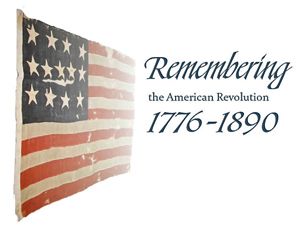
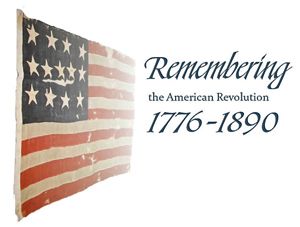
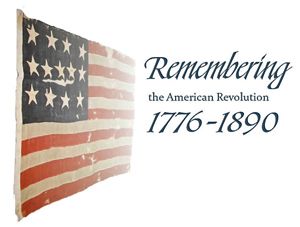
Remembering the American Revolution: 1776-1890
How do you create a collective memory? The new nations’ first three generations of citizens shaped our memories of the American Revolution. People saved and created items to commemorate the struggle for independence to keep Revolutionary ideals alive during an era of great change and conflict. These objects form the foundation for our own memories. These are highlights from Remembering the American Revolution 1776-1890.







Before the Revolution, there was no common American identity; citizens identified themselves with their colony. After the United States’ implausible victory, the ratification of the Constitution and the election of the universally admired George Washington as president helped lay the foundation for an American consciousness.
Items from the Revolutionary era, never plentiful to begin with, were often used into extinction by a frugal citizenry. Objects that were owned by patriots, but that often had no direct role in the War, were therefore seized upon as touchstones to the War. Washington and everything associated with him became exemplars of what was worthy of commemoration. Anything that could be connected to him was valued and saved.
Objects directly connected to the American Revolution are rare. Muskets, the primary weapon for both armies, were turned in when soldiers mustered out, or altered for hunting if taken home. American uniforms are even scarcer. Alternatively, family members saved items not obviously martial in appearance, but associated with the individual who participated in the Revolution.
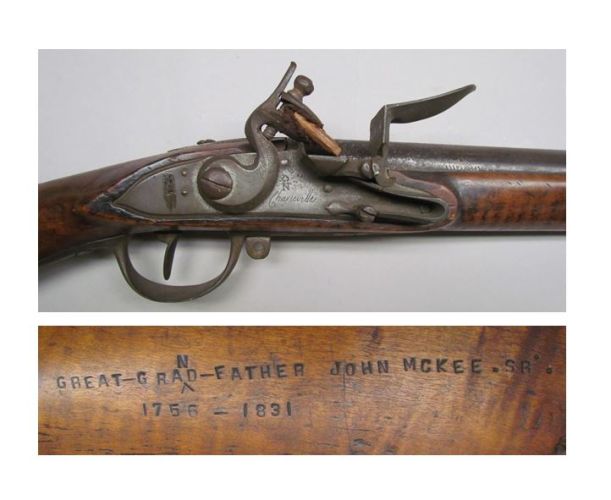
John McKee, the original owner of this musket, served in the American ranks as a private and helped carry the wounded Marquis de Lafayette’s stretcher to a hospital at the Battle of Brandywine on September 11, 1777. When Lafayette arrived in America to join the fight for independence in 1777, he donated many French-made flintlock muskets to the revolutionary cause that were used throughout the War. A descendent had the inscription “Great grandfather John McKee Sr. 1756-1831" placed on the musket.
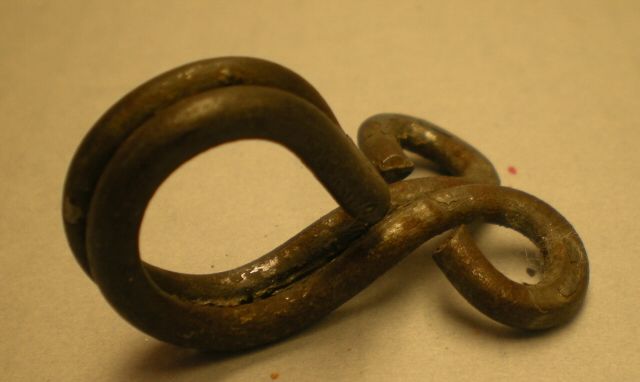
Connections to the Revolution are not always large and grand. This hook was taken from George Washington’s field tent by William B. Barney when it was displayed in 1824 at Fort McHenry in Baltimore. He presented the hook to his daughter Rebecca Barney.
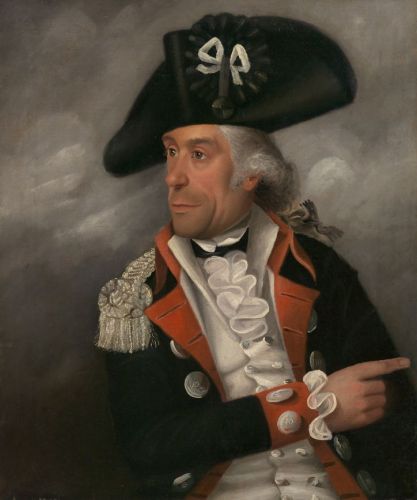
Christopher Marshall served throughout the Revolutionary War and was present at the dramatic surrender of General Cornwallis at Yorktown. He was an Adjutant in the Tenth Massachusetts Regiment and eventually attained the rank of Captain. In this post-war portrait, he chose to be portrayed in his uniform with buttons bearing the number “10” to denote his regiment. The epaulette indicates rank.
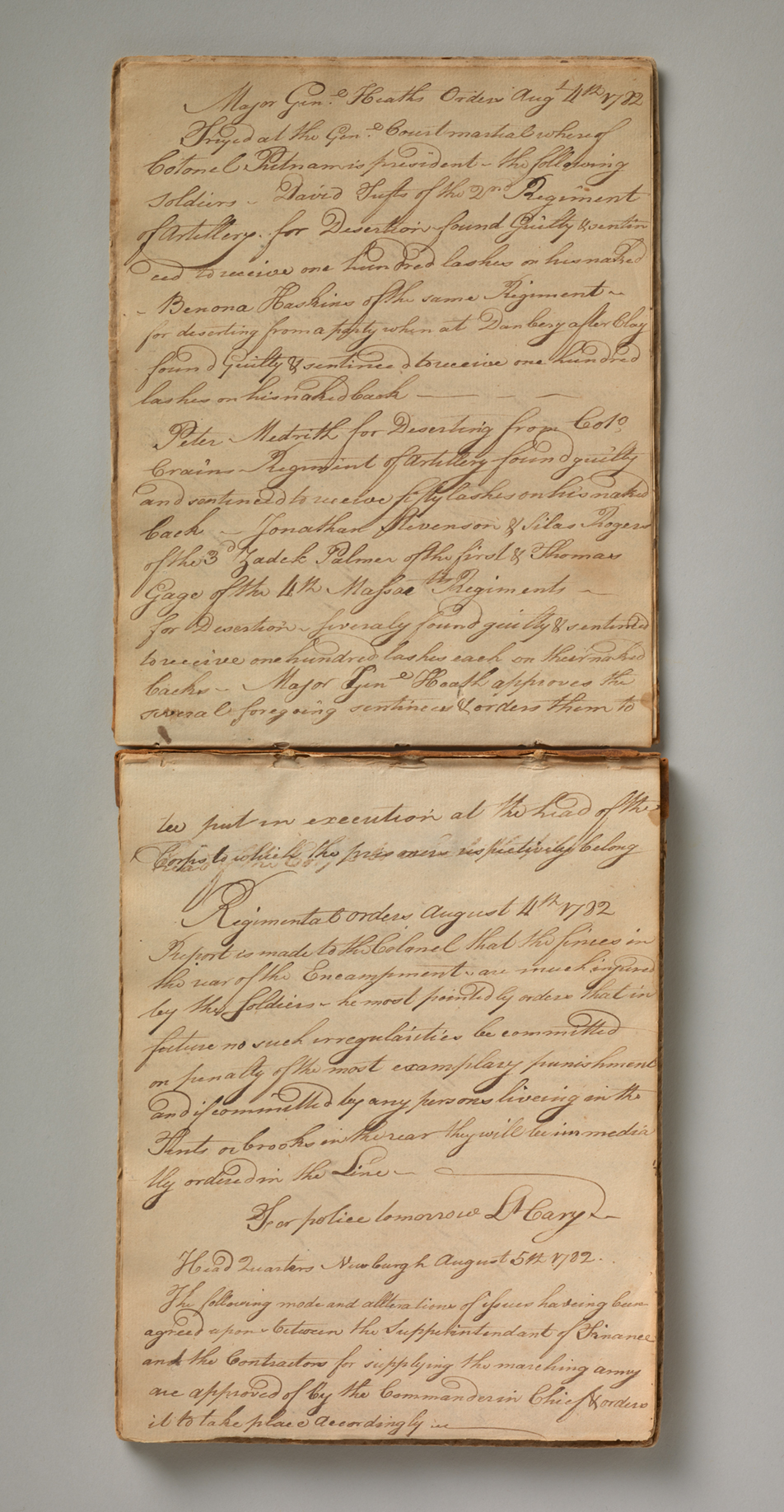
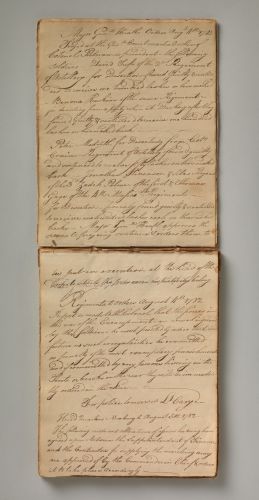
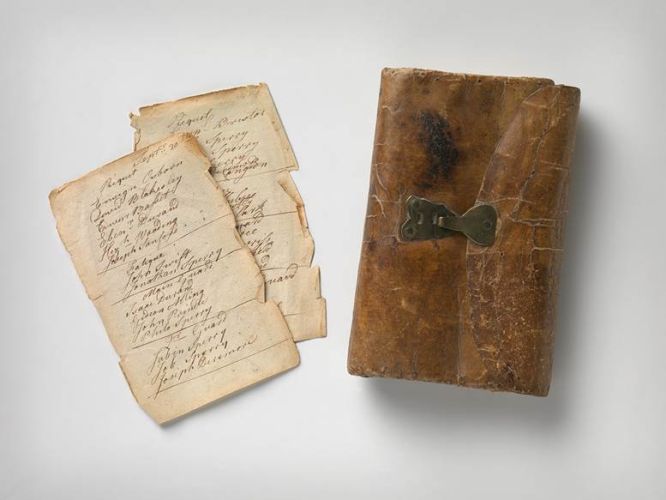
A Revolutionary War orderly book contains a record of daily orders, courts-martial, and other important events. This orderly book was kept for Captain Christopher Marshall from July-October 26, 1782. It was given to National Society Daughters of the American Revolution by Marshall’s great-great granddaughter.
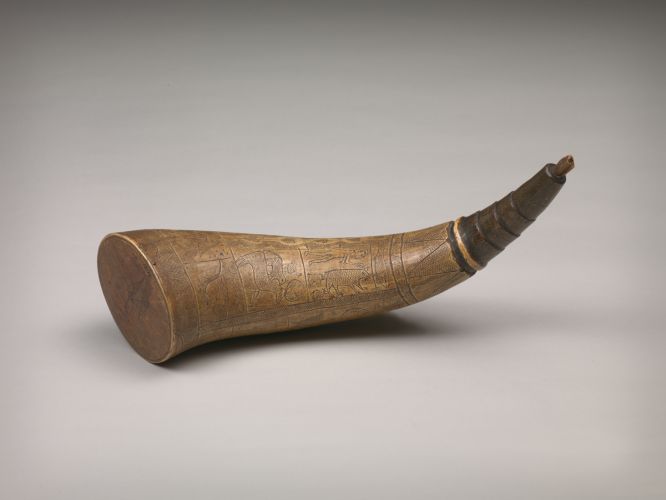
Private Moses Blood from Pepperell, Massachusetts, owned this horn that is decorated and inscribed with his name and “1749”. According to family history, Blood carried this powder horn during his campaigns in the French and Indian War (1754-1763), as well as in the American Revolution, where he served under Captain John Nutting and Colonel William Prescott.
Lieutenant Jabez Pritchard was one of several men who “Marchd from Derby [Connecticut] for the Relief of Boston” in April 1775 and was discharged in December. He later reenlisted, was captured in August 1777, and died on a British prison ship that winter.
His wallet, with its paper notepad containing daily troop maneuvers, inventory of the troop’s cooking supplies, and financial transactions (including winning a pair of stockings on a wager), was preserved by his family until it was donated to National Society Daughters of American Revolution in 1933.
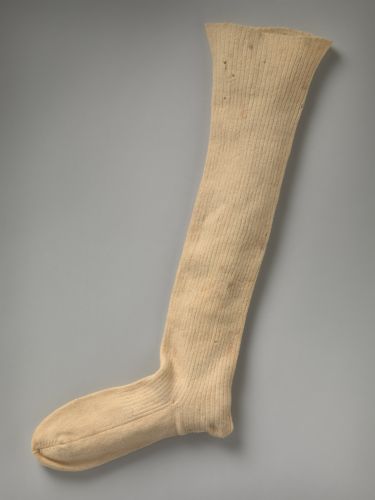
Sarah Benjamin owned this stocking. Like other women who followed the army during the Revolution, she accompanied her soldier husband. Throughout 1780 and 1781, she baked and sewed for the troops and once served as a sentinel. After the War, she was awarded a pension as a soldier’s widow, not for her own service. Still, fourteen Daughters of the American Revolution members have joined on the basis of Sarah’s deeds.
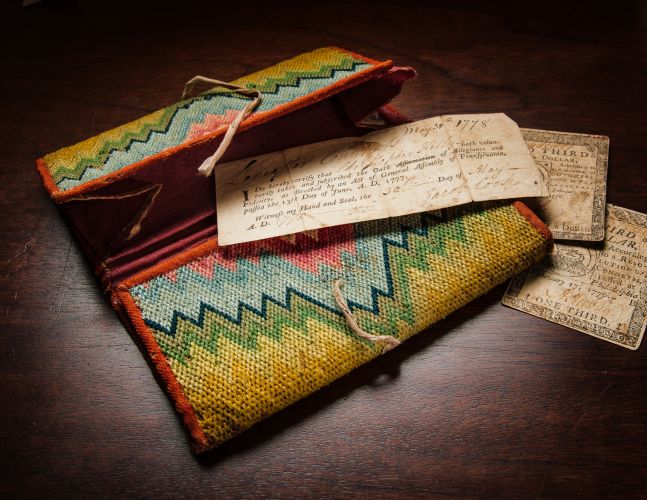
Many men carried wallets like this made by wives or other family members and embroidered in “Irish stitch” zig-zag designs. This wallet was used by Corporal Christopher Ketley (the family later changed the spelling) of Lancaster County, Pennsylvania. His signed Oath of Allegiance to the United States was kept for many years inside the wallet and was donated with it.
Some items were kept and treasured because they were used by people notable at the time: members of the Continental Congress, officers in the Revolutionary armies, and their patriotic spouses. For many years, objects related to the Revolutionary elite were considered the most worthy of preservation. Hagiographic excess, however, sometimes resulted in misleading identifications and associations.
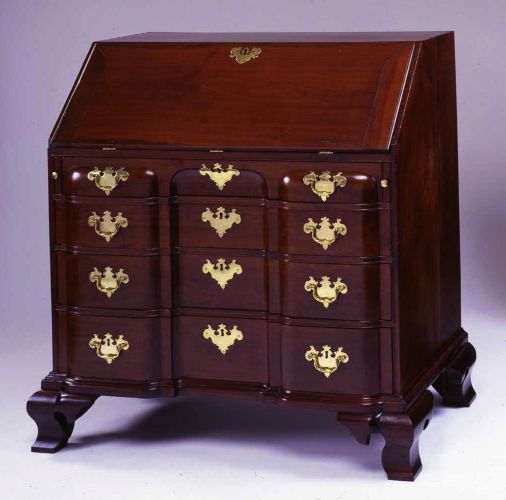
This desk originally belonged to Captain Christopher Marshall from Boston, Massachusetts. After Marshall’s death in 1804, the donor’s family passed this desk down in the family. Later generations enjoyed the desk’s connection to their Revolutionary War ancestor.
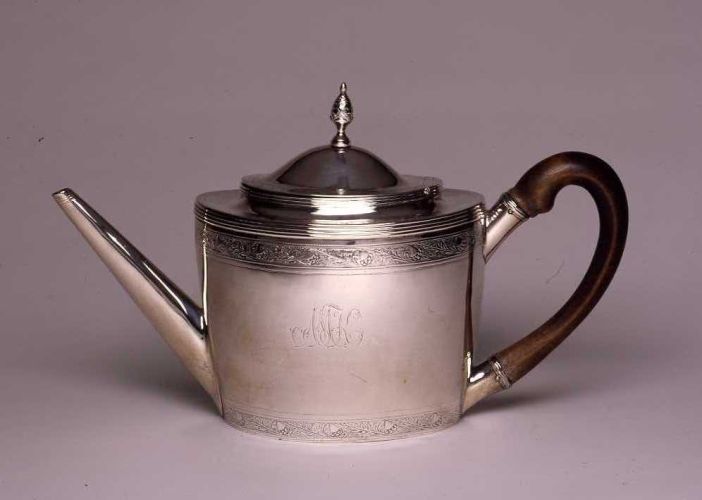
Paul Revere is most known for his legendary ride immortalized in the 1860 poem by Henry Wadsworth Longfellow. Fewer people know he was a silversmith and metals entrepreneur. Revere owned brass and iron foundries and a copper rolling mill. When this teapot was made for Agnes McKean of Boston, Revere’s son, also named Paul, had joined the business, which was known as Revere and Son.
George Washington’s popularity among the Revolutionary generation was not solely based on his battlefield accomplishments. Again and again, he insisted the democratic experiment that members of the Continental Congress devised be given a chance to work. Though he could have retained power after the War, Washington resigned his commission to return to private life at Mount Vernon.
This teacup and saucer, originally part of a large tea set, bear the cipher of George Washington. Washington received a “present of eligant [sic] china” from the Count de Custine in 1782. Custine not only served under Washington at Yorktown, but he also owned the factory that made the tea set.
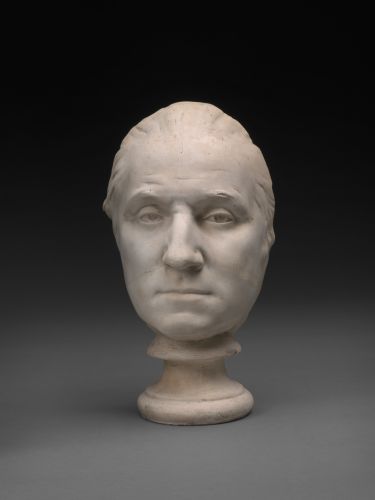
Life masks captured what a person truly looked like in an age before photography. In 1785, sculptor Jean Antione Houdon traveled to Mount Vernon and made a mask of George Washington’s face to aid his creation of a bust of the Revolutionary War hero. In the 1800s, plaster molder August Lenci advertised copies made from Houdon’s mold and reportedly made this mask for artist Emmanuel Leutze, who painted the famous Washington Crossing the Delaware.
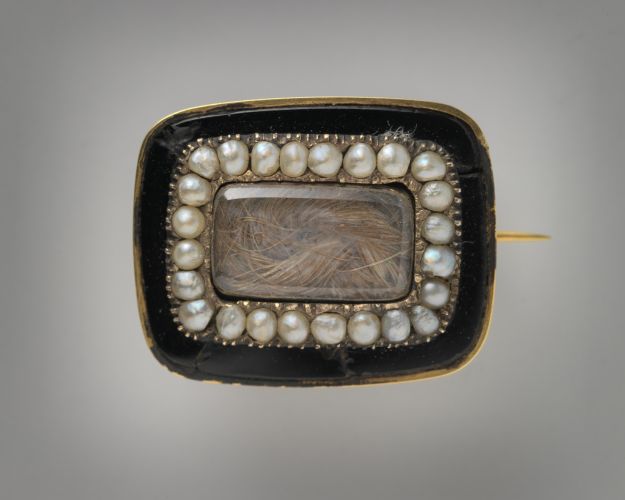
A brooch containing a deceased loved one’s hair under glass was a common gift to a relative and close friend. This brooch is engraved on the back “hair of George Washington,” and was owned by Eugenia Washington, one of the NSDAR’s founders and a great, great, great niece of George Washington.
The unanimous electoral vote that resulted in George Washington’s presidency in 1789 remains the only one of its kind in American history. His qualifications were tied closely with the Revolution (commander-in-chief) and with the drafting of the Constitution (president of the 1787 Constitutional Convention). Americans, thrilled with his momentous inauguration, avidly saved souvenirs for posterity.
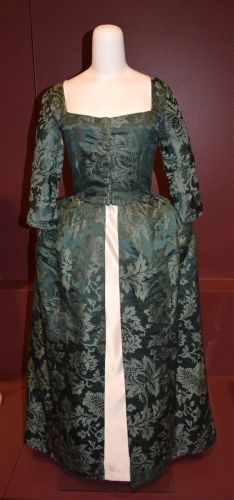
Molly Waterbury, daughter of Brigadier General David Waterbury of Stamford, Connecticut, wore this dress to George Washington’s 1789 Inaugural Ball held in New York City. For generations after that, female descendants have worn the dress and had their photo taken in it. Sleeve ruffles and a net fichu from the 1800s were added later to evoke the 1780s.
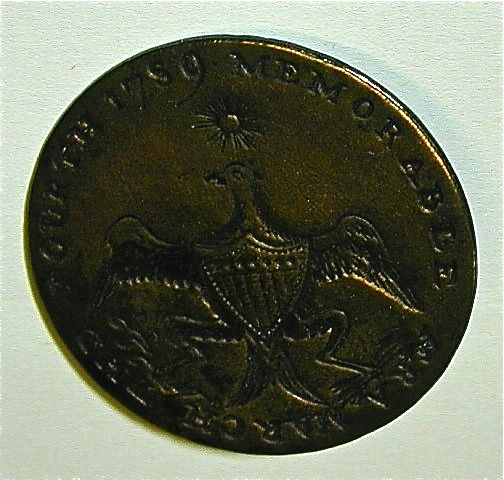
Inscribed “Memorable Era March the Fourth 1789,” this button was produced to celebrate the inauguration day of George Washington. And indeed, witnessing the inauguration of the political experiment known as the United States was certainly memorable.
“Our own are the last eyes that will look on men who looked on Washington; our ears the last that will hear the living voices of those who heard his words. Henceforth the American Revolution will be known…by the silent record alone.”
--EB Hillard, The Last Men of the Revolution
The country mourned the December 1799 death of the illustrious Washington. Though not the first veteran of the Revolution to die, his death was a signal of what was to come throughout the 1800s; eventually those who formed the new nation would not be present to provide guidance. How would the ideals of the Revolution be perpetuated? Who would remember the sacrifices of the founding generation?
To Mourn and To Elevate
George Washington died December 14, 1799, at his home at Mount Vernon, Virginia. Solemn funeral processions took place in every city across the country during the first weeks of 1800. The sad parades were an outpouring of grief and an illustration of national unity. Authors, orators, and publishers offered hundreds of eulogies to the lost Father of the Country.
To Mourn and To Elevate
This book contains original mounted photographs and biographical sketches of six American Revolution veterans still living in 1864. The veterans include: Lemuel Cook (aged 105); Samuel Downing (aged 102); William Hutchings (aged 100); Adam Link (aged 102); Alexander Millener (aged 104); and Daniel Waldo (aged 102). These veterans were the last direct link to the War, and the publication of this work sparked national interest in the six surviving veterans.
To Mourn and To Elevate
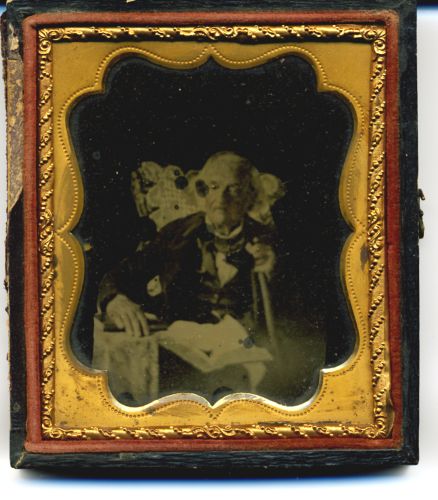
When William Hewes sat for this photograph, the technology was new but it immortalized the Revolutionary War veteran. Hewes was born in 1761 and joined the 2nd Regiment New Hampshire Infantry in 1780, serving under Lieutenant Colonel George Reid. Hewes died in Illinois in 1855.
To Mourn and To Elevate
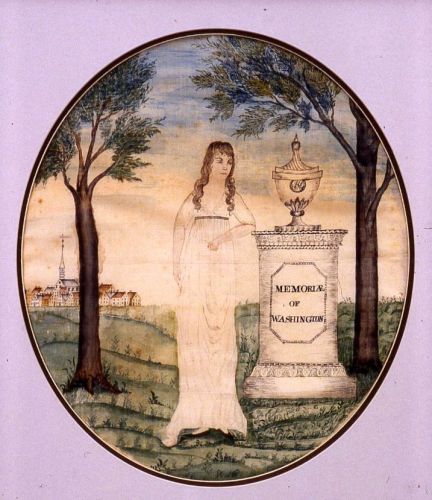
Following George Washington’s death, individuals created personal memorials to the late president and American Revolution hero. Unlike many painted or silk embroidered tributes, this painted memorial to George Washington is accomplished in a simple manner. Perhaps the initials “TH” on the urn provide the identity of the unknown maker.
To Mourn and To Elevate
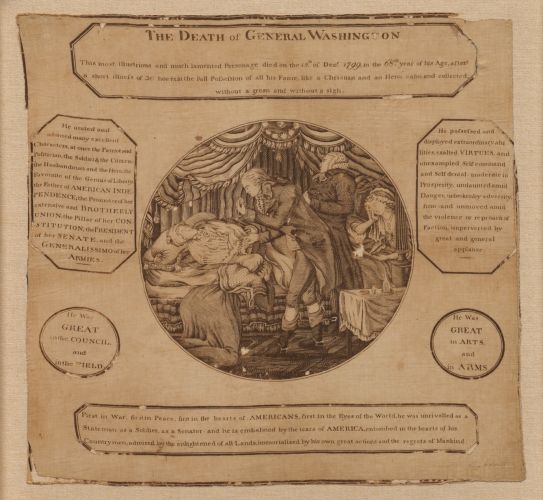
Printed cotton kerchiefs, like this one, were available for sale in dry goods stores across the new nation. The scene here is based on an American engraving depicting Washington’s personal secretary’s account of the first president’s dying hour, published in many newspapers. The kerchief lists attributes for which Washington was so admired.
To Mourn and To Elevate
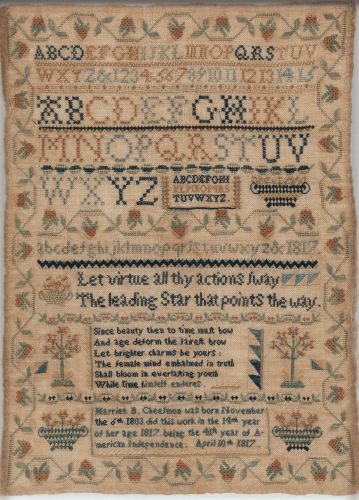
Harriet B. Cheesmon of Cumberland County, NJ, stitched a conventional sampler filled with alphabets, floral images, baskets, verses, and delightful strawberry borders. But, unexpectedly,the words in her signature block convey proud remembrance of the Revolutionary War.
Harriet B. Cheesmon was born November/ the 6th 1803 did this work in the 14th year/ of her age 1817 being the 41st year of A-/merican Independence. April 10, 1817.
To Mourn and To Elevate
Long after George Washington’s death, commemorative items continued to be made and sold to Americans wanting to express their patriotism.
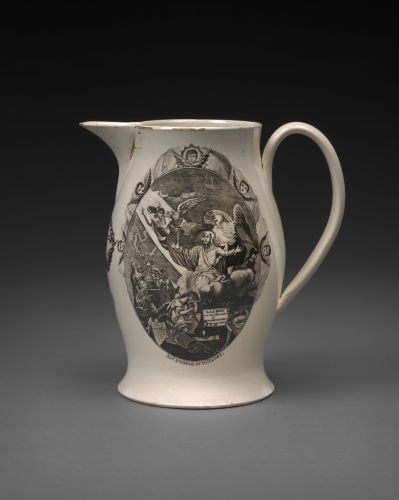
Classical Greek and Roman imagery appeared on memorial products and associated Washington with a god-like status, otherwise known as apotheosis. Venerating him using this imagery meant everyone could understand his status in the country.
This pitcher memorializes Washington by showing him ascending to the heavens. The United States Seal and an 18-link chain represent the states then in the Union.
To Mourn and To Elevate
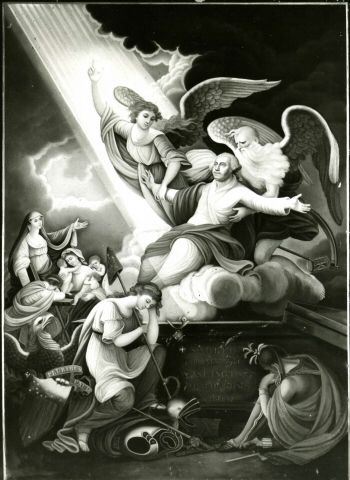
Unprecedented national mourning followed George Washington’s untimely death on December 14, 1799. This engraving was one of many items produced for the grieving public with an apotheosis theme.
As the new country faced trials of the 1800s: The War of 1812, the Mexican War, economic uncertainties, and increasing tensions over the future of slavery, images of Washington were joined by other Revolutionary luminaries. Benjamin Franklin, Thomas Jefferson, John Adams, and others were emulated as wise and courageous leaders. The Industrial Revolution meant many more products with Revolutionary imagery could be affordably produced for millions of Americans.
George Washington was a role model for American children, particularly after Parson Weems wrote his 1800 biography introducing the myth of the cherry tree. This pair of children’s handkerchiefs, intended to be cut in two, points out how “the love of truth mark the boy.” The companion handkerchief invites the reader to “behold the man,” showing that Washington grew up to fulfill his early promise of greatness and integrity.
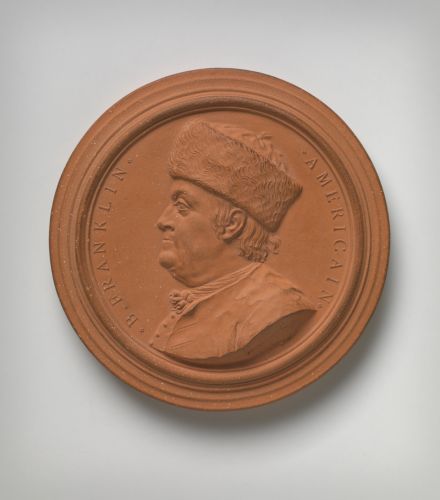
Benjamin Franklin became America’s first ambassador when he was sent to France in 1776 with instructions to form an alliance. Franklin’s down-to-earth manner so endeared him to the French that they created many likenesses in his honor. Easily and cheaply reproduced clay medallions made Franklin’s face famous among the French. In this terra cotta profile, his trademark fur cap accentuates a carefully cultivated “western” image.
Working in the major cities in the eastern United States, the French portraitist Saint-Memin created hundreds of realistic profiles of clients of national and local note. This engraving is from a series of portraits of famous Americans and is based on his original crayon portrait of Thomas Jefferson. It remains one of the best known images of President Jefferson.
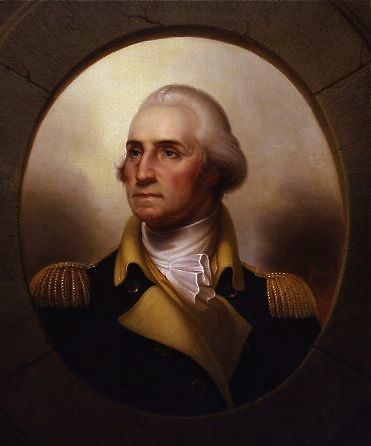
In 1795, Rembrandt Peale, the 17-year-old son of famed artist Charles Willson Peale, first painted President George Washington. Throughout Peale’s life he tried to perfect that image. Recognizing a market for his portrait, he painted more than seventy copies of this well-known image, depicting Washington in both military and civilian dress. Peale painted the oval frame on the canvas, creating the “porthole effect.”
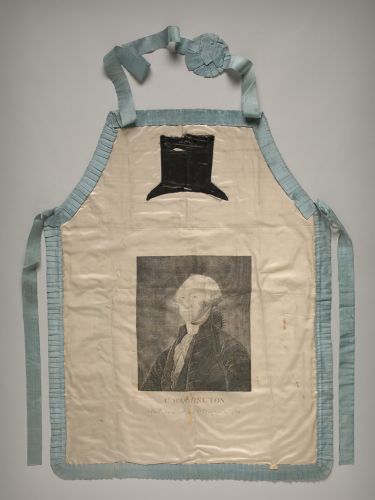
This apron was worn in a parade in New York City in the early 19th century to commemorate the centennial of Washington’s birth.
Marie-Joseph Paul Yves Roch Gilbert du Motier, Marquis de Lafayette, was a French aristocrat who supported the Revolution with such zeal that he crossed the ocean to join the Continental Army. He was 19 years old, but gained immediate popularity among the Americans. As part of Washington’s staff, he provided valuable assistance bridging the cultural divide between the structured French soldiers sent to aid the rebelling colonists and the more egalitarian American troops. Lafayette and Washington developed a close friendship that would last beyond the war.
In 1824, Lafayette, as he was popularly known in the United States, revisited the country he helped create. The Revolutionaries were dying off. President James Monroe, a veteran, invited him and hoped the great Frenchman’s visit would reenergize America’s memory of the Revolution. Lafayette had not been forgotten. His ambitious tour of the 24 states then in the union included parades, balls, and parties everywhere he went.
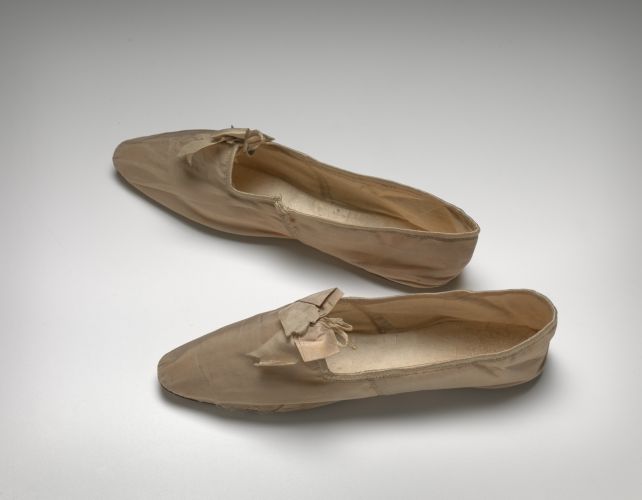
Women across the country were thrilled to dance with Lafayette at balls in his honor. To remember their brush with greatness, women kept their dresses, shoes, fans, and other items as mementoes. Angelica Gilbert James of New York City saved these shoes from her memorable dance.
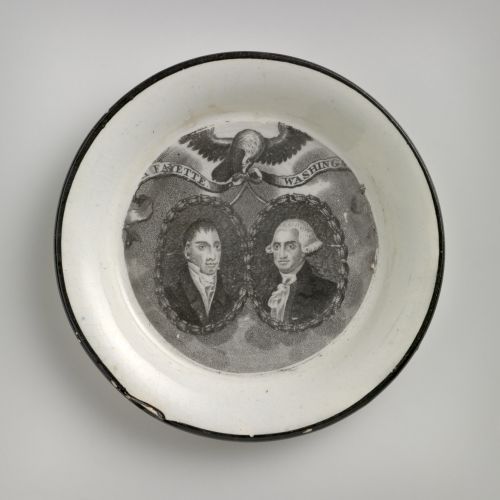
Made for the American market, this plate celebrates George Washington, as well as the Marquis de Lafayette’s visit to the United States between July 1824 and September 1825. Americans expressed their patriotism by purchasing such commemorative tableware.
The Civil War brought the Revolution back into everyday conversation. Women organized massive fundraising fairs to support troops that featured Revolutionary War themed programs, displays of relics and “colonial kitchens,” and supporters of the Union and the Confederacy each used references to the nation’s founding to bolster their side. President Abraham Lincoln’s Gettysburg Address, considered to be one of the greatest speeches in American history, began “Four score and seven years ago our fathers brought forth on this continent, a new nation, conceived in Liberty, and dedicated to the proposition that all men are created equal.”
The 100th anniversary of the founding of the country occurred in 1876, and a grand Centennial Exposition in Philadelphia drew people from around the nation. Once again, a “colonial kitchen” made an encore appearance. All of the Revolution’s actors were gone and a new, romantic view of the nation’s founding had taken hold.
Patriotic Products
The Centennial Exposition was intended to celebrate the Revolution and to showcase the accomplishments of American industry. Expanded industrial production meant cheaper goods, some which displayed images of Washington, the Founding Fathers, or Revolutionary War scenes. The items were popular among Americans both old and new. Those with historical ties to the War could promote their pedigree by displaying a coverlet with patriotic designs. Recent immigrants could purchase a lithograph or an inexpensive bookmark with Washington’s face to herald their adopted country’s ideals.
Patriotic Products
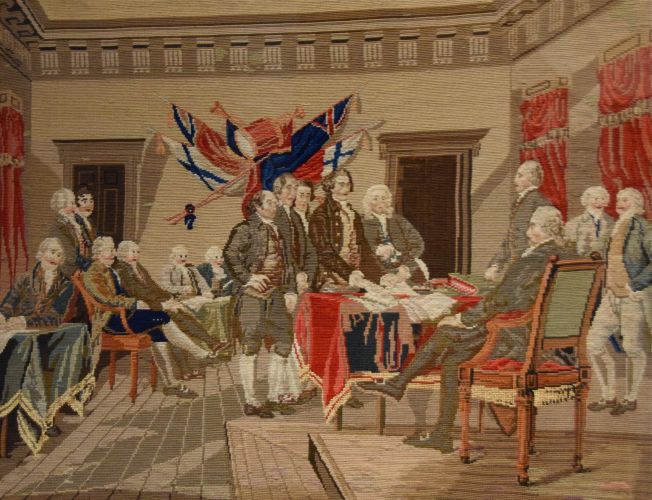
Sarah Raynes executed a needlework picture on patterned canvas based on the famous painting The Declaration of Independence by John Trumbull. This was one of many similar patriotic patterns made for the American market in the mid-1800s.
Patriotic Products
Reproductions of famous items relating to the American Revolution were popular during the colonial revival movement that began in the late 1800s. This armchair is a copy of the famous “Rising Sun” chair located in Philadelphia’s Independence Hall. The original chair was made by John Folwell in 1779 for the speaker of the Pennsylvania legislature. Carved into the top are a sun and liberty cap. During the Constitutional Convention debates in 1787, Pennsylvania delegate Benjamin Franklin observed that the chair’s sun was rising, and not setting, on the new nation.
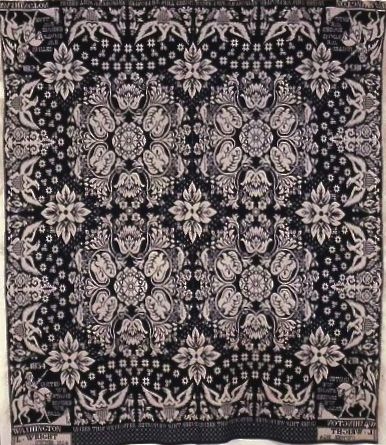
Cunningham and Butterfield, weavers in partnership through 1835, used patriotic motifs in their coverlets’ borders and corners. The date 1824 in the corner may refer to Lafayette’s visit, though 1834, the date of the weaving, also appears.
By the end of the 1800s, objects connected to the War for Independence were in the hands of family members, collectors, and museums. The desire for individuals to own a piece of the Revolution remained, however, instigating a rise in relic collecting. People collected anything, no matter how tenuous, that might be related to the Revolution-pieces of buildings, snips of fabric, and even chunks of trees.
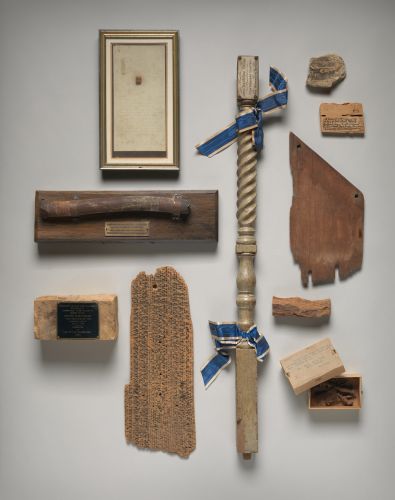
Bits and pieces of wood and metal represent Americans’ desires to connect with the nation’s early history, particularly the Revolution. Individuals collected and saved tangible evidence of their ties with people, events, and structures from the war. Some relics are a framed piece from George Washington’s casket (upper left); a copper bolt from the USS Constitution, possibly made by Paul Revere (middle left); shingles, wood fragments, and plaster from historic buildings; and a baluster (with blue and white ribbon) made from wood taken from John Hancock’s demolished house.
This chair was made out of wood salvaged from the British battleship HMS Augusta, which sank off the coast of New Jersey in 1777. In the early 1900s, members of the New Jersey DAR received salvage rights to the remains and had both paneling and furniture made for a period room in DAR headquarters building.
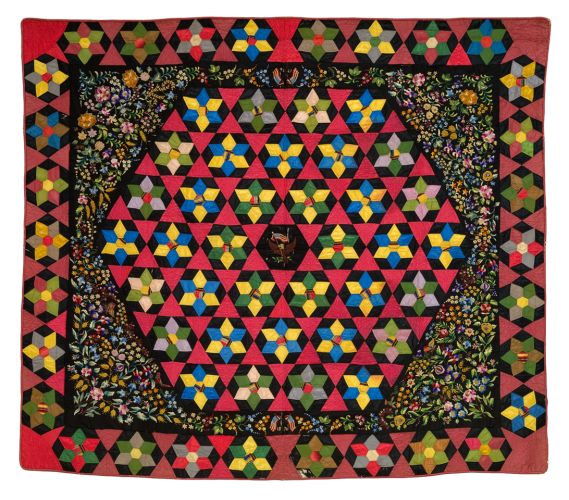
Family history relates that this silk patchwork was exhibited at Philadelphia’s Centennial Exposition. American eagles holding flags with “1876” and “1776” mark the Centennial.
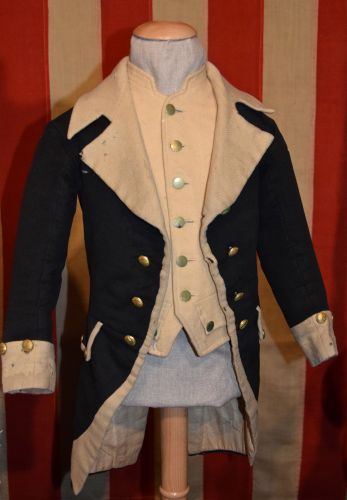
Young William Mapes wore this costume, meant to represent George Washington’s Revolutionary War uniform, to Centennial celebrations in his hometown of Newburgh, New York, in 1876.
The Centennial Exposition in 1876 and the 100th anniversary of Washington’s inauguration in 1889 kept the Revolution alive in people’s minds. Americans were on the move, following jobs in a newly industrialized country. Immigrants arrived from Eastern Europe by the millions in the last decades of the 1800s. These factors led many to want to strengthen their ties to their own history. In 1890, when they were prevented from joining hereditary organizations run by men, a group of women formed the National Society Daughters of the American Revolution.
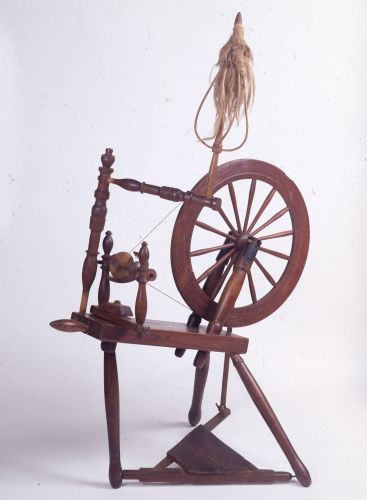
Dr. G. Brown Goode based his design for the NSDAR’s insignia on this wheel, used by his grandmother Rebecca Hayes Goode of Amelia County, Virginia. The insignia was adopted by the Society on May 26, 1891.
Caroline Scott Harrison was First Lady of the United States when she gave this speech to the members of the newly-formed National Society Daughters of the American Revolution. The women were attending the first Continental Congress, as the annual meeting of the organization is called. It is believed that this speech is the first public address ever made by a First Lady.
Click on the speech to enlarge and read.
Explore this Exhibit
Explore More Online Exhibitions
By, For, and Of the People: Folk Art and Americana in...
Selections from this DAR Museum gallery exhibition show the charming and beautiful work of...
The Storytellers
By the late 19th century, collectors recognized the charm of American schoolgirl samplers...
Coming to America
From the earliest days of colonization in North America, sewing traditions arrived with...
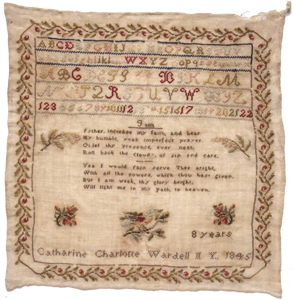
In Search of Answers: A New York Survey
A survey of 22 New York samplers in the DAR Museum collection was undertaken in 2003-2004...
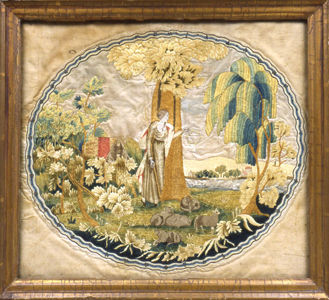
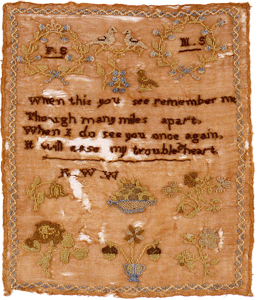
Telling Their Story: Going Away
To European visitors, nineteenth-century Americans appeared constantly on the move. They...
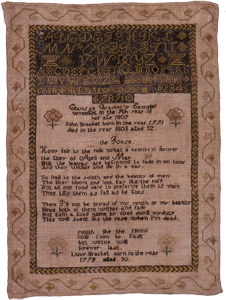
Words from the Past
Sampler verses have long fascinated those who study the needlework canvas. Here are a few...
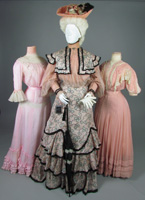

Creating the Ideal Home, 1800-1939: Comfort and...
October 2, 2013 - August 30, 2014 It's human nature to like shortcuts; people are always...

Retro Rooms
The DAR Museum’s period rooms have evolved much over the past century. Many of the period...
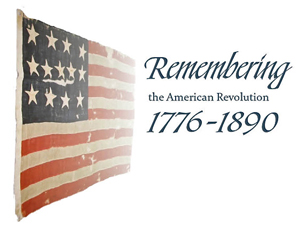
Remembering the American Revolution: 1776-1890
How do you create a collective memory? The new nations’ first three generations of...

DAR Museum Period Rooms
Explore the American Home! Each of these 31 period rooms looks like you’re stepping into a...
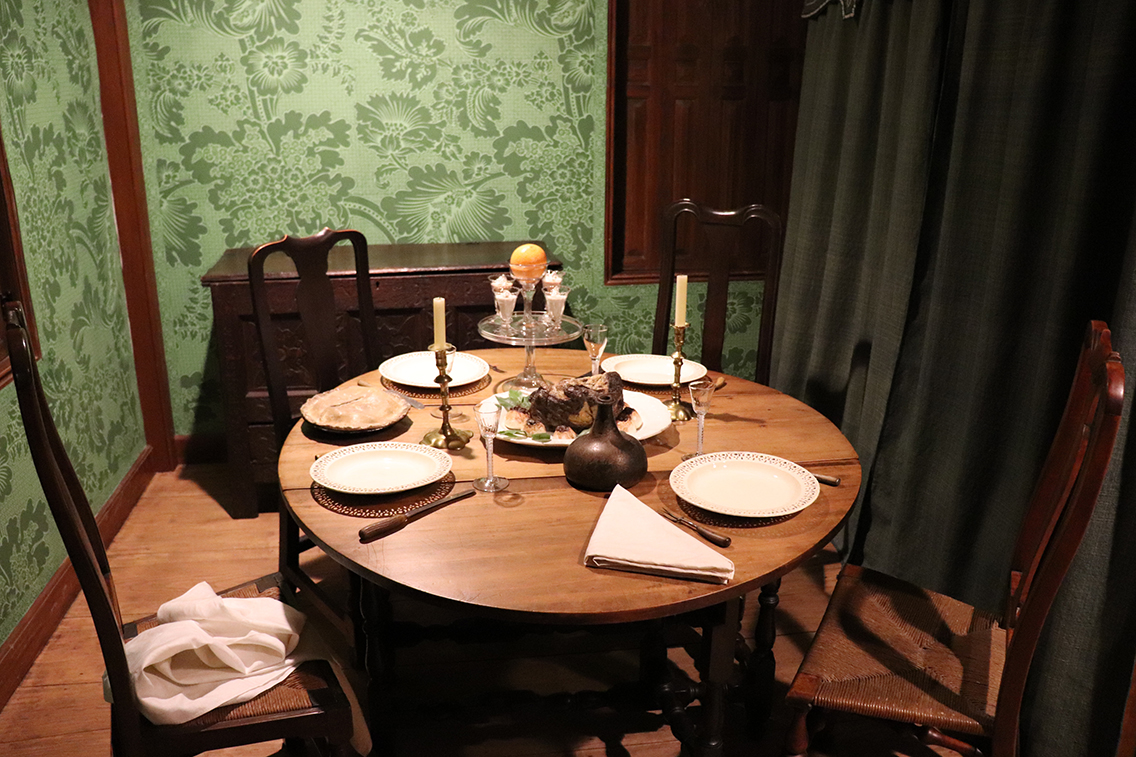
Songs of Christmas Past
You’ll be humming your favorite Christmas songs as you view a selection of the period...
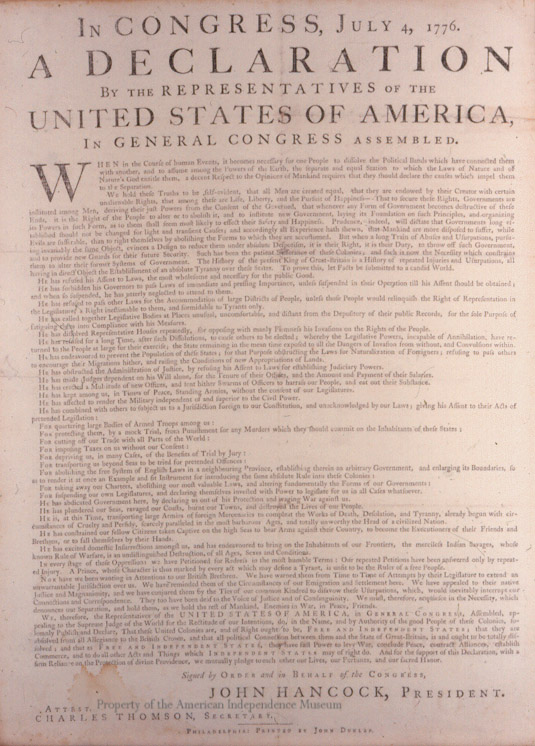
Rare Historic Documents on Loan at the DAR Museum
This summer from May 26 – July 9, a Dunlap Broadside, as well as the two draft copies of...