
|
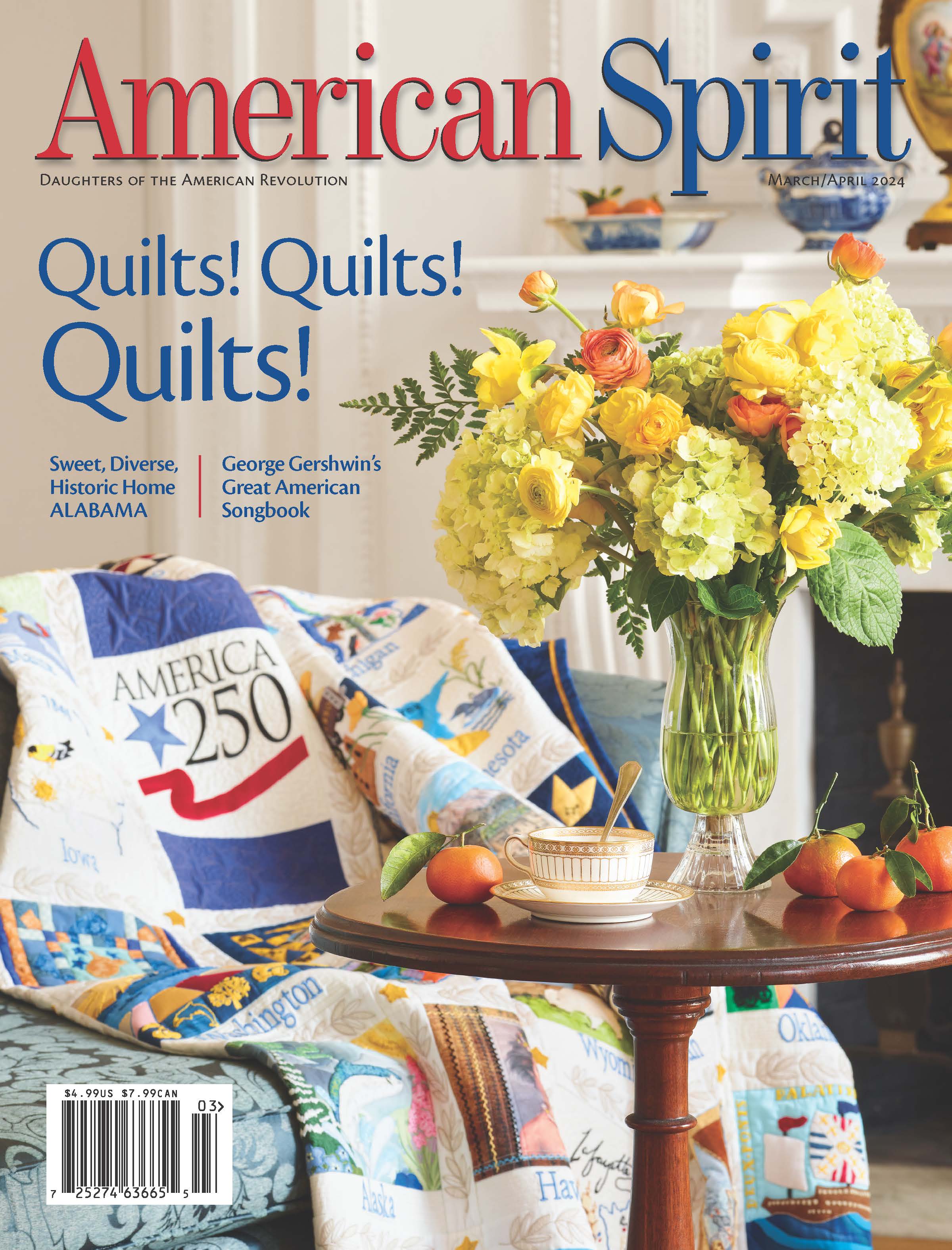
The award-winning American Spirit magazine is a handsomely illustrated, bimonthly publication focusing on issues that are important to us all. Articles cover such subjects as American history, historic preservation, patriotism, genealogy and education. Whatever your interests, you will find informative, entertaining and engaging articles in each issue of American Spirit magazine.
Subscribe or renew online now! Featuring reduced rates for multi-year subscriptions.
May/June 2013
Today's Daughters
Glimpse into the lives and passions of the diverse group of women who comprise today’s DAR membership.
National Treasures
Take a step inside the DAR Museum for a closer look at its fascinating collection.
More Articles
Learn about the interesting historical articles from this issue.
Upcoming Issues
Details on exciting stories that will be featured in upcoming issues of American Spirit.
Through a Veteran's Eyes
By Lena Anthony
Photograph courtesy of Laura Kennedy
Volume 147, Number 3, May/June 2013, Page 5
Since she was a little girl, Laura Kennedy knew she wanted to perform in front of a camera. In high school, she fine-tuned that goal and set her mind to becoming a TV reporter, later graduating from the Walter Cronkite School of Journalism and Mass Communication at Arizona State University with a degree in broadcast journalism and human communication. Today, she’s a reporter for the CBS station in Springfield, Mo.
Now that she’s been a TV reporter for more than three years, she says her favorite part of the job isn’t being on camera—it’s being out in the community and meeting the people behind the stories she reports. She met dozens of World War II veterans while working on a story about the Honor Flight Network, which enables World War II veterans from across the country to visit the World War II Memorial in Washington, D.C., free of charge. Then a TV reporter for the NBC affiliate in Billings, Mont., Ms. Kennedy was selected as the media representative for Montana’s second Honor Flight to Washington, D.C.
“The whole thing was a whirlwind,” says Ms. Kennedy, a member of the Anasazi Chapter, Glendale, Ariz. “And it was really touching. For most of them, it was their first time to Washington, D.C. Most of them hadn’t even left the state since the war. The receptions in Washington and when they arrived back home were just incredible, as if the war had just ended.”
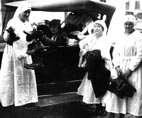
Among the veterans on her flight were three women who, once at the memorial, migrated to the inscription dedicated to women. “They started taking pictures and talking to tourists,” she says. “And I realized that visiting our nation’s capital with veterans can add a whole new level of depth to that journey. We’ll never be able to meet George Washington or Abraham Lincoln, but we can meet these veterans who experienced war.”
Ms. Kennedy says her involvement in the DAR, which she joined shortly after her 18th birthday, helped her appreciate the experience. “One veteran I talked to said his grandchildren never want to hear his World War II stories,” she says. “I wish that all 20-somethings were as interested in talking to veterans. Those 20-somethings are going to grow into 50-somethings and wish they could have heard these stories when they still had a chance.”
After returning to Billings, Ms. Kennedy became an advocate for the Honor Flight Network. In fact, when she was visiting family in Arizona last Christmas, she found out that her grandmother was eligible for the program and helped her get on the waiting list for Arizona’s next Honor Flight.
Ms. Kennedy submitted a DAR application on her own when she was still in high school, after discovering that her great-grandmother on her father’s side had been a member. “I wanted to join because it’s a really great organization that you have to be born into,” she says. “I’m the only female grandchild, so I knew that if I didn’t join, it wouldn’t be a part of our family in the current generation.”
Ms. Kennedy says she also appreciates the support she receives from her fellow members. “They’re a wonderful group of friends. They look out for me and care so much about my career,” says Ms. Kennedy, who, despite living in Missouri, is still active as her chapter’s corresponding secretary.
Outside of work and the DAR, Ms. Kennedy stays busy scuba diving, singing in a community choir, and volunteering at local elementary schools and through the Big Brothers Big Sisters program. Before leaving Montana, she received a community service award from the governor’s office.
For more Today’s Daughters, please click here.
To nominate a Daughter for a future issue, e-mail a description to americanspirit@dar.org.
Ornamental Trio
Photography by Stephanie Livingston
Volume 147, Number 3, May/June 2013, Page 6

These elegant Classical urns were made in England in the late 18th century. Though unmarked, they are attributed to the potter Ralph Edwards II (1748—1795). Pottery with a marbleized surface is known as agate ware. Made by molding colored clay onto the surface of the pottery, agate ware mimics the variegated appearance of its namesake stone.
Decorative sets like these are called garnitures. They were crafted in sets of three, five or seven, and often placed upon a fireplace mantel shelf. Visitors to NSDAR Headquarters can see these agate ware garnitures displayed on the mantel in the DAR Museum's West Virginia period room. The Museum purchased the set in 1964.
For more National Treasures, please visit the DAR Museum's Featured Objects.
Passing Along a Passion
By Nancy Cooper
Photography by Paul F. Efird Jr.
Volume 147, Number 3, May/June 2013, Page 13

According to the National Assessment of Educational Progress’ 2010 Civics Assessment, students in the nation’s secondary schools lack a proper understanding of civics. Among some of the report’s key findings:
- Fewer than half of American eighth graders knew the purpose of the Bill of Rights.
- Only one in 10 eighth graders demonstrated acceptable knowledge of the checks and balances among the legislative, executive and judicial branches.
- Three-quarters of high-school seniors were unable to name a power granted to Congress by the Constitution.
That’s why the work of American history teachers like William Anthony Malone of Horace Maynard Middle School in Maynardville, Tenn., is so essential to building the critical thinking skills needed to help students become responsible citizens. Malone tries a number of inventive strategies to get his students on board with the subject he loves—including sponsoring a club that promotes civics education and historic appreciation, encouraging the use of primary sources to illustrate the lives of historical people, and using a team-teaching approach that allows him to share his passion for favorite eras.
His sponsorship of the eighth-grade History Club sparks students’ interest in civic involvement. The club establishes a government of its own, electing a president, vice president, secretary, a representative from each class and senators. Many of Tennessee’s current state senators and representatives, Maynardville’s mayor, and other community leaders have attended the club officers’ formal swearing-in ceremony. The club also takes trips to living history museums and historic landmarks, and for the past 16 years, members have taken a weeklong trip to Washington, D.C.
In his classroom, Malone utilizes primary sources to help students connect to the people behind historic events. He and his wife Renita Disney Malone, a fifth-grade history teacher, are participating in a three-year grant from the East Tennessee Historical Society to establish guidelines for teaching American history from primary sources.
“So many original documents, such as journals or diaries, are available online and often are more effective than reading textbooks,” he says.
Three years ago, he and fellow history teacher Kristie Dean started a class swap experiment—and that experiment is paying off. Sharing the instruction of around 240 students, the educators teach their favorite eras of American history. Malone’s favorite time periods are the road to the Revolution, the westward expansion of the United States, and the Lewis and Clark expedition. Partially as a result of this teamwork, the eighth grade’s annual standardized test scores have improved, and Malone says scores “went through the roof” last year.
Malone, a University of Tennessee graduate, says, “I was fortunate in college to have had a history teacher who seemed to bring it all to life. I knew then that teaching was what I wanted to do. But it’s not enough to take the courses and memorize dates; to be effective, you need to be passionate, the subject needs to excite you and the ensuing enthusiasm has to be passed on to the students.”
That enthusiasm was noticed by one of his students’ grandmothers, a member of the Bonny Kate DAR Chapter, Knoxville, Tenn., who nominated him for the Tennessee DAR Outstanding Teacher of American History award, which he won in 2012. (Through the DAR, Malone found out that one of his ancestors, John Ousley, served in the Revolution.) A popular vote by students and citizens recently named him Union County School System’s Teacher of the Year.
FEATURES
The Great Colonial Hurricane of 1635 by Nancy Mann Jackson
The fury wrought by hurricanes is well-chronicled, yet modern meteorology provides some warning. For Colonial Americans, however, these fierce storms hit with complete and destructive surprise.
The Coast Guard: Always Ready Since 1790 by Courtney Peter
The United States Coast Guard was initially created to raise revenues and help pull the nation out of debt. It has evolved into a guardian of our shores, a protector of our borders and an “Always Ready” life-saving service.
A Revolutionary Band of Brothers by Bill Hudgins
Though the Society of the Cincinnati initially stirred fears of aristocratic influence in the new nation, it reclaimed esteem by commemorating Revolutionary events and people and promoting the appreciation of early American ideals.
DEPARTMENTS
Spirited Adventures: Paducah, Ky., and the Bluegrass Region by Matt Ward
We explore a river town enjoying a renaissance as an arts and crafts center, as well as surprising attractions along the Blue Grass Parkway.
Historic Homes: The Hermitage by Jamie Roberts
A refuge from a tumultuous public life, Andrew Jackson’s Hermitage now welcomes visitors as a lovingly preserved presidential landmark near Nashville, Tenn.
Genealogy Sleuth: More Than a Keepsake by Lena Anthony
Donating personal artifacts to a museum can not only honor a family member, but also give researchers a broader, more vibrant view of history.
Our Patriots: Marinus Willett by James S. Kaplan
Few know of this Son of Liberty’s brave 1775 stand against the British, or his influential role in the nation’s formation.
Bookshelf reviews Houses of the Founding Fathers: The Men Who Made America and the Way They Lived by Hugh Howard
Also: Whatnot and the President General’s Message
To purchase an issue of American Spirit, contact magazinesubscriptions@dar.org
To subscribe to American Spirit, visit Subscribe.
To Come in the July/August 2013 issue of American Spirit
D. W. Griffith Films the Revolution
Stone-Carved Treasures of the John Stevens Shop
Spirited Adventures: Bristol, R.I.
Historic Homes: The Octagon in Washington, D.C. |