
DAR Headquarters, including the DAR Museum and DAR Library, will be closed to the public on Saturday, June 13 
due to street closures and access restrictions connected with an area event. Additionally, street traffic and parking 
in the area will be significantly restricted in the days leading up to and following the weekend events.

American Spirit Magazine

March/April 2026

Glimpse into the lives and passions of the diverse group of women who comprise today’s DAR membership.

Meet Our Members

Family Tradition

From member to leader to advocate, this Indiana Daughter has made a lifelong commitment to C.A.R.

By Lena Anthony

If you’re wondering how Vicki Voris feels about the National Society Children of the American Revolution, consider this: Even before her children were born, their membership paperwork was complete.  

“All we needed was their birth certificates,” said Mrs. Voris, National Chair of the Continental Congress Committee and member of Eagle Creek DAR Chapter, Indianapolis, Indiana.
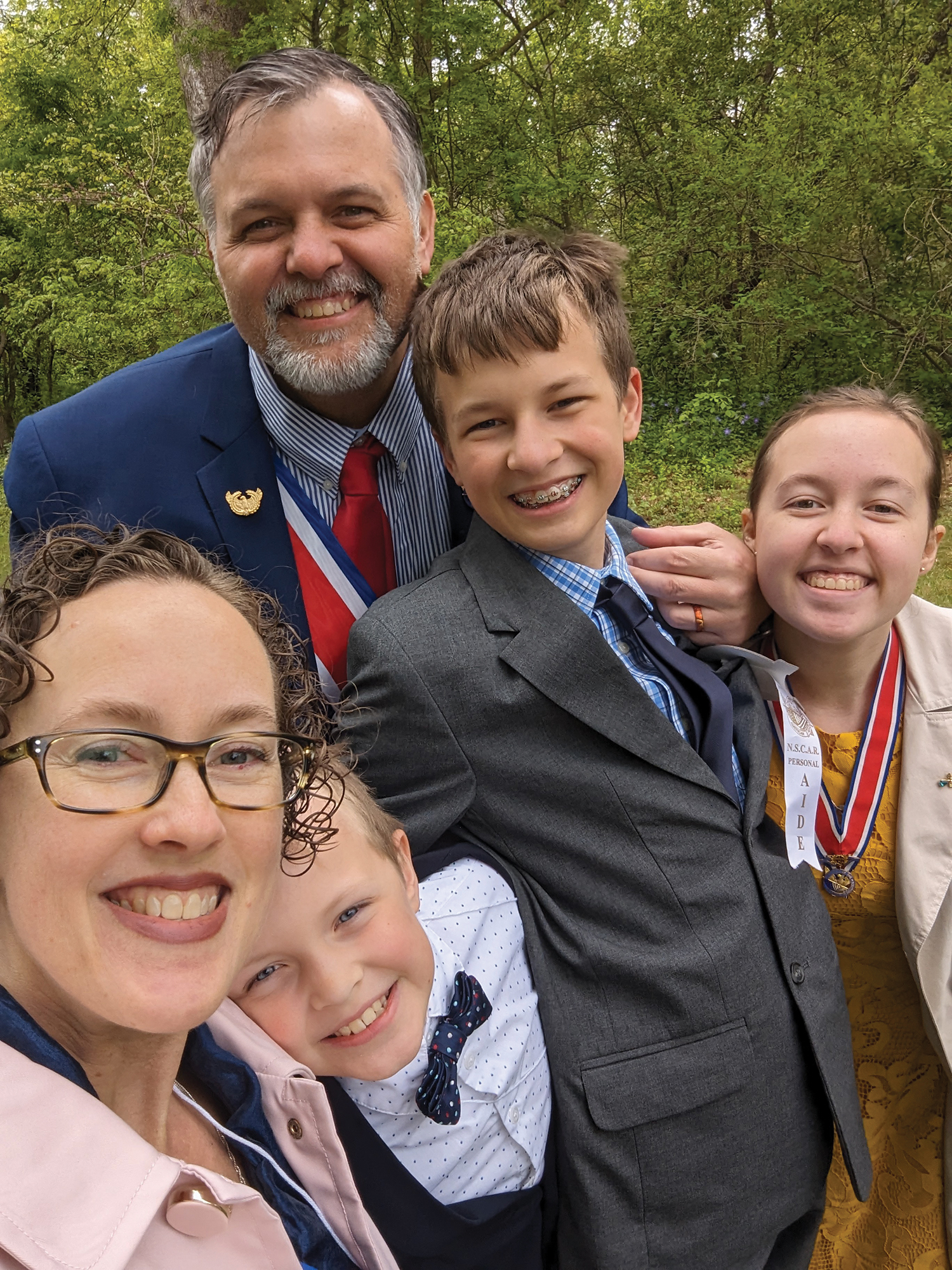
Since childhood, Mrs. Voris has been involved with the organization. First, it was as a member in Morven Society, Children of the American Revolution, in Princeton, New Jersey. Then came leadership roles as state president and national chair and various positions on the national board. She met her husband, Jeff, at a regional meeting for C.A.R., and they reconnected (and eventually married) years later.  

Today, with a family of their own, C.A.R. remains an integral part of their lives. Mrs. Voris previously served as National Chair of the DAR Children of the American Revolution Committee. Her husband currently serves as Senior National President of C.A.R. And their children—Malorie, JT and Liam—have each served as president of their local Little Eagle Creek Society.

Malorie, a standout in speech and debate, now serves on the national level. JT was selected as one of only two students to represent his Indianapolis school before the school board, and Liam completed his own term as president while still in elementary school.

“It truly is a family tradition,” Mrs. Voris said. “I’m grateful for the role C.A.R. played in my life as a child, because it helped foster the dedicated DAR member I am today.”

She credits the C.A.R. with giving her a vital foundation in public speaking, community service, historic preservation and love of country—instilling values of patriotism, support for Veterans and civic responsibility that have shaped her active involvement in DAR and enabled her to pass those same skills and ideals on to her own children and the C.A.R. members she has mentored over the years.

“The C.A.R. provides young people with meaningful opportunities to develop public speaking skills, leadership skills and civic understanding,” she said. “These are best learned through participation and service, and C.A.R. gives youth the confidence and foundation to step into those roles. It has been especially rewarding to see my children and their friends benefit from the same experiences that shaped me as a young person and to watch those lessons take root in the next generation.”

Mrs. Voris’ C.A.R. experience has extended naturally into her professional life. She is vice president for customer success at a software company that provides solutions for local government. Her work includes public speaking, client training and problem-solving—skills she credits to her years as a C.A.R. member and later as a DAR Page at Continental Congress.  

“Being able to problem-solve on your feet and serve others with a smile came directly from those earlier experiences,” she said.

For Mrs. Voris, C.A.R. is more than an organization. It’s a family bond. “C.A.R. offers families the opportunity to spend meaningful time together doing something they all enjoy,” she said. “With so many projects and activities, there are countless ways to live out the C.A.R. motto, ‘For God and My Country.’ It’s a wonderful way to combine family time with a shared love of country.”

When they’re not participating in C.A.R. activities, the Voris family enjoys traveling and hosting family game nights.  

“Either for spring break or fall break, we always like to take the kids somewhere we’ve never been in our state,” she said. “I think it’s important to learn where you live and see all it has to offer.”  

Favorite games include Rummikub, Euchre and, when someone is busy, Labyrinth. “It’s only a four-person game, and with all the activities the kids are involved in, we’re frequently short a family member.” 


America's Treasure

Welcome to ‘America’s Front Yard’

The National Mall and Memorial Parks symbolize our nation’s democratic ideals.

By Kim Hill 

From its 18th-century origins, it was intended as a democratic public space in the heart of the nation’s new capital city. French artist and military engineer Pierre L’Enfant, who was appointed by President George Washington in 1791 to plan Washington, D.C., envisioned a 400-foot-wide garden-lined “grand avenue”—an egalitarian space open to all, the exact opposite of palace gardens like Versailles, which were paid for by the people but accessible only to a privileged few.

Over the more than 200 years since then, this grand avenue—the National Mall—has symbolized the nation’s democratic ideals for all visitors to our capital city. Stretching from the foot of the U.S. Capitol to the Potomac River, “America’s Front Yard” is the country’s premier civic space. National Mall and Memorial Parks (NAMA), a unit of the National Park Service, protects the National Mall and its iconic monuments, memorials and more than 1,000 acres of green space. They have become iconic representations of the country, instantly recognizable globally and frequently featured across media and public imagery. 

New Museums Join Historic, Cherished Symbols 

The list of monuments and memorials interpreted, maintained and preserved by NAMA is iconic: the Washington Monument, Thomas Jefferson Memorial, Lincoln Memorial, Franklin Delano Roosevelt Memorial, World War I Memorial, World War II Memorial, Korean War Veterans Memorial, Vietnam Veterans Memorial, Martin Luther King, Jr. Memorial, Pennsylvania Avenue from the Capitol to the White House, the National Mall, East and West Potomac Parks, Constitution Gardens, more than 60 statues, and numerous other historic sites, memorials and green spaces.

The National Mall, which hosts more than 36 million visits per year, is one of the most popular parks in the world. To help keep this cherished space ready for visitors, several partners assist NPS, including the Trust for the National Mall, a nonpartisan nonprofit. The Trust leads capital restoration projects, mobilizes volunteers and provides educational experiences to ensure the National Mall endures for future generations. The Trust’s Vice President of Communications, Julie Moore, notes that every monument and memorial on the National Mall was either built or restored in part through private donations.

She said a recent project is the restoration of the Lockkeeper’s House, the oldest structure built on the National Mall. Completed in 1837, the house sat at the intersection of two canals, where the lockkeeper collected tolls and kept records for merchandise entering the city center. Over the years, the house served multiple uses, but it was empty for nearly 40 years before it was moved to its current location and restored.

“It’s now a mini museum that acts as a gateway to the National Mall,” Moore said. Visitors can learn about the Mall’s history, from L’Enfant’s original plans through the haphazard growth throughout much of the 1800s, when the space held a jumble of public and industrial buildings.

Revitalizing “America’s Front Yard” became the project of the Senate Park Commission, created in 1901. The commission’s report and subsequent plans to redesign the National Mall became known as the McMillan Commission, named after Sen. James McMillan of Michigan. Drawing heavily on L’Enfant’s vision, the McMillan plan more than doubled the size of the Mall and continues to provide a basis for planning museums and memorials. 

One new structure is the U.S. Park Police Horse Stables and Wells Fargo Education Center, which include tactile exhibits featuring saddles, grooming tools and more to help visitors learn about the long history of mounted units on the National Mall.

Revitalizing Iconic Places and Spaces  

Future projects include the restoration of Constitution Gardens and the 56 Signers of the Declaration of Independence Memorial. “Constitution Gardens was originally built for the Bicentennial in haste on construction fill,” Moore said. The current site is underutilized, environmentally problematic and costly to maintain. “The shallow lake is not sustainable for wildlife,” she said, and it is difficult to care for. 

Restoration plans include creating a deeper and reengineered lake to improve water flow and viable habitat for wildlife, 36 acres of gardens for educational opportunities and public recreation, and restoration of the Signers Memorial, with interpretative signage and QR codes for visitors to understand the significance of the signatures. Moore anticipates a 2026 groundbreaking for that project. 

Similarly, Lafayette Park’s legacy dates back to L’Enfant’s original plans. Renovations in Lafayette Park will include restoration of the park’s garden elements, green spaces and the signature fountains; new walkways will be created along with other enhancements to the park from which many visitors first glimpse the White House. Moore anticipates this project will be completed just in time for the Semiquincentennial. 

The Lincoln Memorial Undercroft Museum should also be completed by July 4. This new museum, located in the cavernous space below the Lincoln Memorial, showcases the memorial’s history and its role on America’s civic stage, Moore said. The project is led by NPS and National Park Foundation, in partnership with the Trust for the National Mall. 

A Unifying Space  

For those who are unable to visit the National Mall in person for the 250th anniversary of American independence, a new digital tool offers the next best thing. The National Mall Gateway is a digital learning platform that launched in fall 2025.

Moore described it as “a whole new way for people to experience the National Mall, whether they’re here in person or visiting virtually from a kitchen table or a classroom.” The tool includes an interactive map and 360-degree tours of the monuments and memorials. “While taking the digital tour of the Martin Luther King Jr. Memorial, for example, you can almost reach out and touch the marble stone,” she said. “Viewers can also read Mall Moments, which are the stories of how those spaces came to be and how they’ve helped shape history.” 

Visitors also can use the tool to research points of interest in advance of their trip to maximize their experiences.

“The National Mall is a unifying space where future generations can learn about America and its founding principles and ideals,” Moore said. “Preserving and restoring the National Mall and its historic purpose for the next generation is a critical and truly noble cause.” 


 March/April 2026 American Spirit

Inside This Issue

More Articles

America’s Treasure: National Mall and Memorial Parks: Welcome to ‘America’s Front Yard’ by Kim Hill

Brave & Bold: Doris Buffett: Giving Without Glory by Alice Schroeder

Historic HomesRemember the Missions of El Paso! by Jeff Walter

Meet Our MembersFamily Tradition by Lena Anthony

My PatriotJane Black Thomas: Embedded in the Revolution by Megan Pacella-Howard

On the Road to 250!: A Declaration That Endures

Our American Legacy: Diplomacy in Full Bloom by Courtney Peter

Our American Legacy: Nancy Ward: Bridging Nations, Cultures and Centuries by Emily McMackin Dye

Travel Log: Hawaii: Ancient and Active by Jamie Roberts

Plus: American Artisans; DAR Museum; DAR Recipe; Genealogy Tidbits; Ideas, Ideas, Ideas!; Illuminations With the President General; News From the DAR Committees; The Story Behind the Pin

To purchase an issue of American Spirit, contact [email protected]